This is a fork of Dechifro's English to Phonemic text tool, I really like it but I found a few pet peeves along the way. Tinkering around the insides of the original webpage was a hassle (trying to find which file had the dictionary for the letters), but it was really easy after i locked in. As of the time i'm writing this (April 1st 2026), it features an alt. Quikscript converter that is assigned to the code points in Fairfax HD, i hope that i can add a bit more in the future.
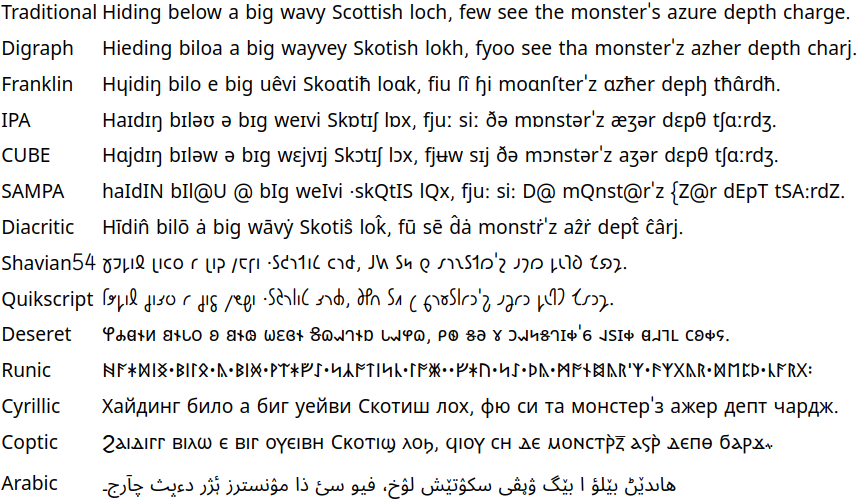
A quick visual comparison:
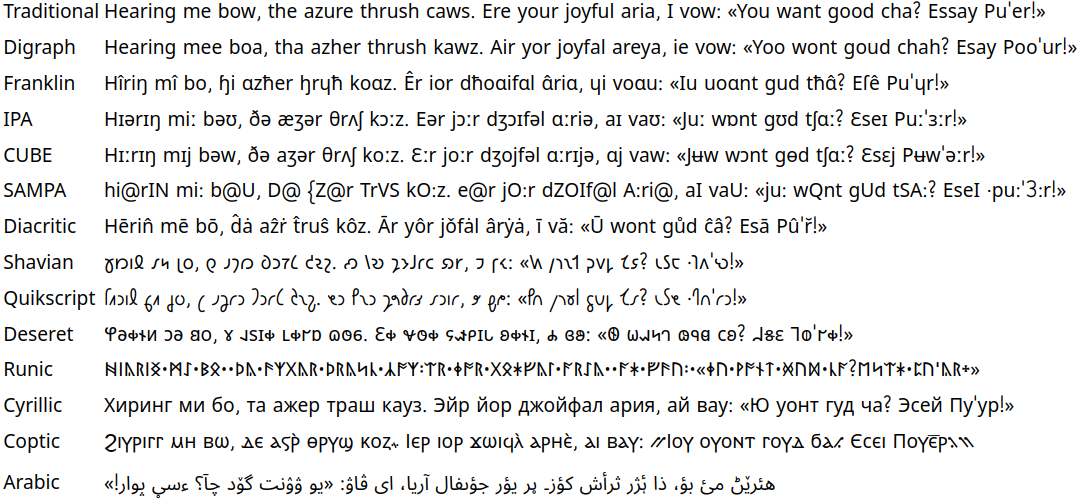
See how your browser and fonts render these lines
Digraph, 2025, by Dechifro. Uses digraphs for the sounds Latin doesn't have, much like the Initial_Teaching_Alphabet. The easiest phonemic script for normies to read because eight percent of words keep their traditional spellings.
Franklin, 1768, by Benjamin Franklin. Long vowels may be either doubled or circumflexed; I chose the space-saving option.
IPA, 1962, by Alfred Charles Gimson. The symbol set used by Wikipedia as well as thousands of dictionaries and ESL textbooks around the world.
CUBE, 2021, by Geoff Lindsey, who says that Gimson got the vowels all wrong, and proposes a more "evidence-based" vowel system.
SAMPA, late 1980s. A 7-bit ASCII version of IPA for QWERTY keyboards. With namer dots because capitalizing any letter changes its sound.
Diacritic, 2025, by me. Uses diacritics for the sounds Latin doesn't have, like the Czech and Vietnamese orthographies.
Shavian, 1960, by Kingsley Read. My favorite, described in great detail here. All translation to other alphabets is via Shavian, so you can copy some Shavian text from the bottom of this page, paste it into the box above, and convert it to e.g. Digraph.
Shavian54, 2022, by Evan Gallagher. Shavian plus six additional letters explained here. At present, only the Inter Alia font displays these letters correctly.
Quikscript, 1966, by Kingsley Read. A cursive form of Shavian. Download the fonts here.
Deseret, 1854. Designed by a committee, and it shows. I follow Marion Shelton's 1860 proposal of using ɪ for the unstressed schwa. Standard Deseret has no such letter; it's either omitted or replaced with various strong vowels, imposing a memorization burden on children.
Runic, 2025, by Rune Revival. This system, based on the Anglo-Saxon runes. To see bindrunes, install the Catrinity font.
Coptic, 2025, by Didymus of Australia and associates. Based on contemporary Greco-Bohairic pronounciation of Coptic script (supplemented by historic pronounciations where necessary) with minimal adaptations to account for phonological differences between Coptic and English.
Arabic, 2013, by Adnaan Mahmood. Explained here on Omniglot. Uses many variants of the letters yeh and waw to cover the English vowels.
Cyrillic transcriptions of English words are common in Russia, not just for brand names but for mundane things like "price list". Multiple phonemes map to T, A, and О, double consonants are preserved, and H can become either Г or Х, e.g. Harry Potter is Гарри Поттер but Pizza Hut is Пицца Хат.
Best of all, you can customize these alphabets or build your own from Unicode's tens of thousands of characters and combining marks. All you need is a Python interpreter, my Python program, and my American and British dictionaries.
NOTE: I have removed a few things to make this less identical to Dechifro’s page, if you’d like to visit the original webpage, it’s here.